A nationwide debate over banning books in schools is playing out in Redlands. In December, the Redlands Unified School District Board of Education voted to remove the novel “Push” by Sapphire from schools, and advocated to limit access to Toni Morrison’s “The Bluest Eye” to students 18 and older. The board is now considering a procedure requiring schools to track which books come into their library, and require principals to approve them.
Meanwhile, campus groups at the University of Redlands are advocating against book banning and working to make controversial books available to all.
Last October, Sigma Tau Delta and the Armacost Library put together a week full of Banned Books activities for the 10th year in a row. Several organizers and attendees expressed that this held more weight than previous ones, as book bans grow increasingly close to home.
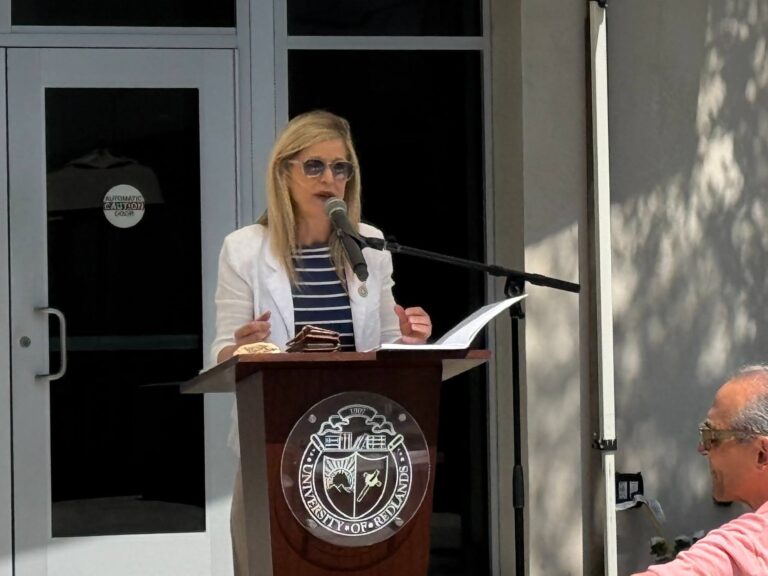
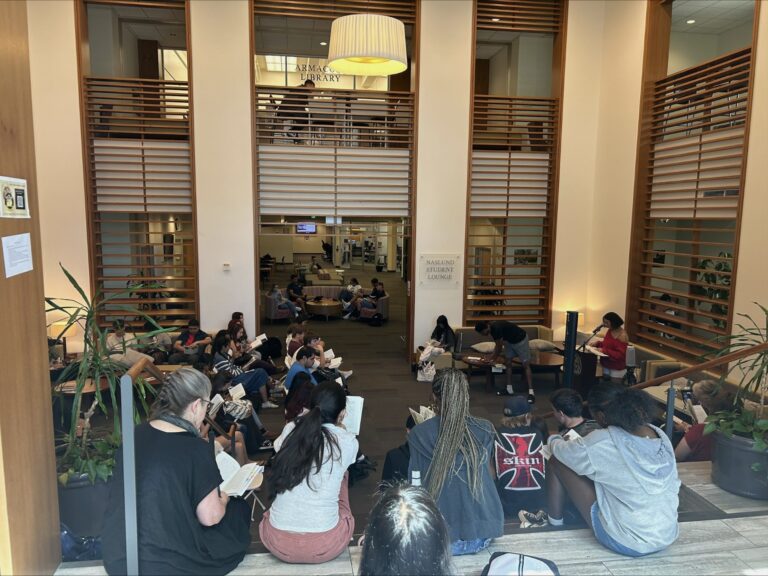
Banned Books Week consisted of four main activities: a Banned Book Listening, a Banned Book Reading, a Documentary Screening and Panel Discussion, and a game of Banned Book Bingo on the final day. These events actively gave students access to free banned books. During the listening, the Hunsaker Lounge had a banned audiobook playing in the background where students could come and go as they pleased. During the reading, a podium was set up in front of the Armacost Library where passersby could pick up a library book and read any passage aloud.
Although Banned Books Week has been a consistent event at the University of Redlands for years, it has recently grown in scale. According to Heather King, Sigma Tau Delta’s advisor, “We’ve been doing the panel discussions for a couple of years, and if we have ten people show up it seems great. So, to have close to 200 there this year was amazing.”
Alana Poyneer, the co-president of Sigma Tau Delta, also commented on the success of the Documentary Screening and Panel Discussion. “A lot of kids I talked to were feeling inspired by the screening because they were seeing kids from other schools protesting all these banned books, because it’s important to them,” Poyneer said.
Organizers said these events are more relevant than ever because of the Redlands Unified School District’s new book-removal process. On Aug. 19 the school board voted to revise its “library materials complaint policy,” in which books can be much more easily challenged and banned when accused of being inappropriate for certain age groups. When books are charged with containing “profanity, pornography, erotica, or graphic depictions of sexual acts and/or violence,” the book in question must be removed within three business days.
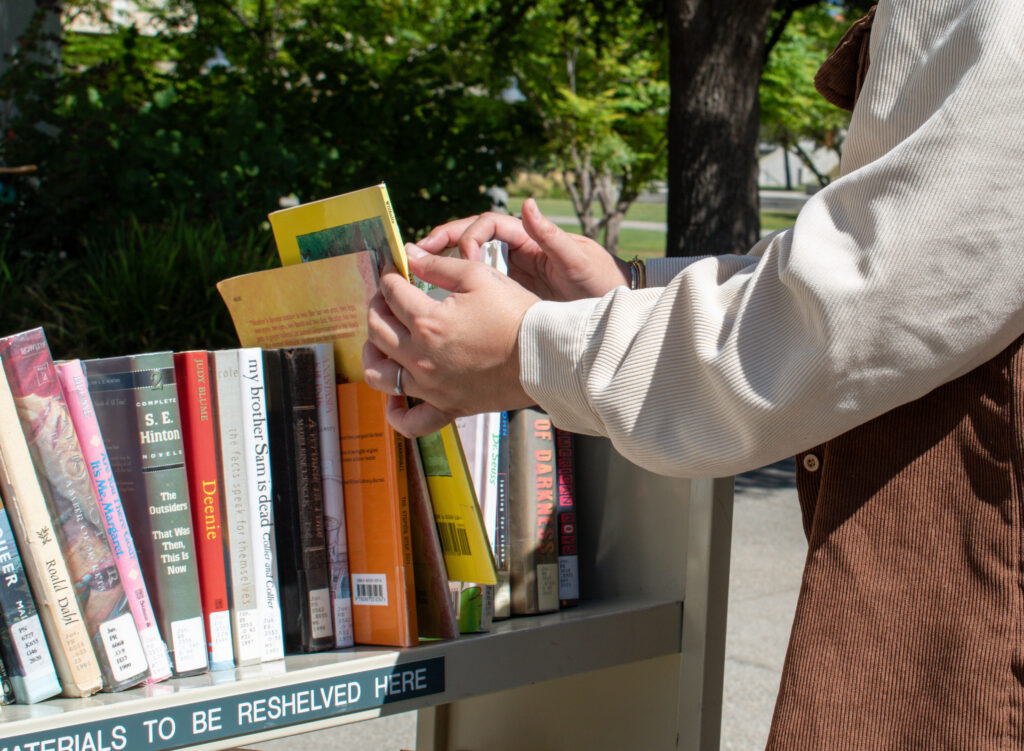
Regarding this new policy, Heather King said, “There were parental safeguards already in place respecting parents’ rights to determine what their students had access to. But the new school board has thrown that out to replace it with a policy that allows any member of the community, whether or not they have students in the school district, to target a book.” She also said that “the details of the new policy make it much more likely that books will be fully banned and un-accessible to all students, based on the complaints. So, it amounts to a book-banning policy.”
Redlands Unified School District board President Michele Rendler, who voted for this policy, said at the Aug. 19 board meeting that “from the time that I was appointed to this board, I have consistently supported keeping sexually explicit books out of our libraries and classrooms, and I’m still of the conviction that children should not be subjected to this material.”
Candy Olson, another board member, said in the same meeting that “we’re not under any obligation to provide material that’s going to be harmful for children. A parent can… go to the library, Barnes & Noble, Amazon, a public library, and check out that material. We are not obligated to provide it.”
Heather King said that “if you’re taking books out of publicly accessible libraries, like those at public schools, that makes it harder for people who can’t afford books to have access to them.”
Furthermore, the policy’s language of banning books with “sexual acts and/or violence” can be applied to a variety of literature, including the potential ban of the book “Speak” by Laurie Halse Anderson, a book previously taught in high school curriculum all across America. Poyneer commented that “it’s dangerous when we don’t have access to these different perspectives and narratives, because then we can’t understand where people are coming from,” and that “it obviously harms the students most of all, the youth.”
“Books that represent marginalized identities can genuinely be a question of life or death,” Heather King said. “There are documented cases of queer kids growing up in situations where they don’t feel safe owning or exploring that identity, and suicidal ideation is frequently a consequence of that. And if they read a book that shows them that they’re normal, or that they’re worthy, or that they deserve to live, it changes that ideation and convinces them to stay around.”
Poyneer said that in general, the problems presented in banned books “are real problems that people go through, and I always thought that reading is a way to deal with those issues safely. I use it as a way to confront my own problems and emotions, and when we take those away, it perpetuates the problem.”
The Redlands Unified School District Board of Education is expected to discuss the issue again at its upcoming meeting on March 10.