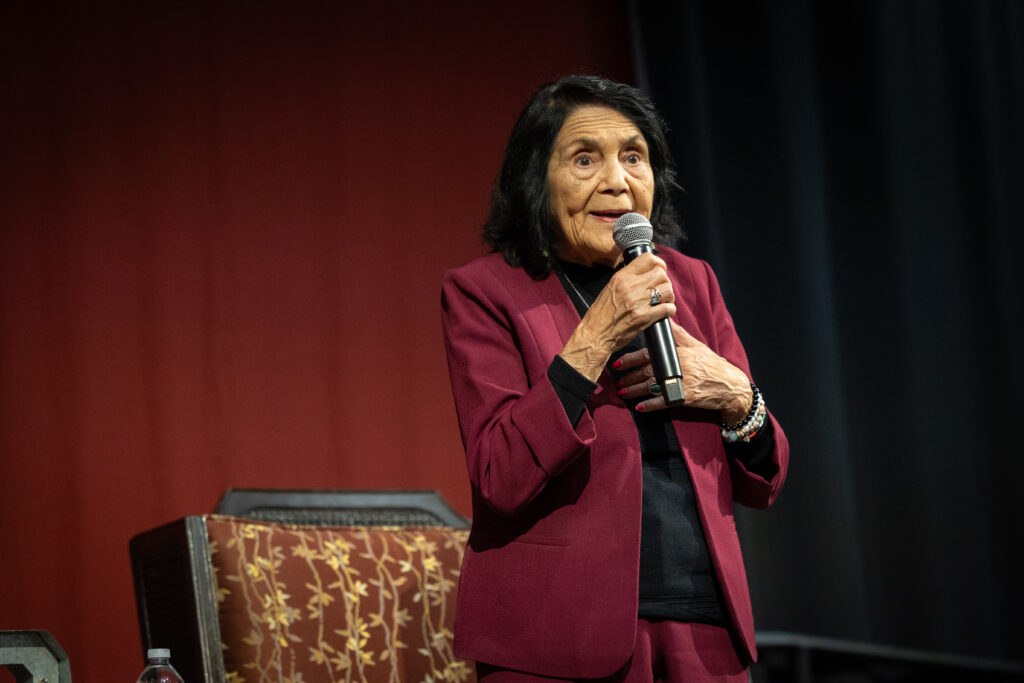
More than 300 people made their way into the University of Redlands’ Orton Center to hear civil rights icon Dolores Huerta top off the March 13 Social Justice Conference.
Setting the Stage
University of Redlands professor and alumnus Everette Davidove ‘15, whose class organized the conference, started off the evening with a welcome and congratulated three students for winning the conference’s art competitions: Natalya Simone Libao ‘26 for art, Catie Whitwood ‘27 for short paper and Lexi Riffel ‘26 for long paper.
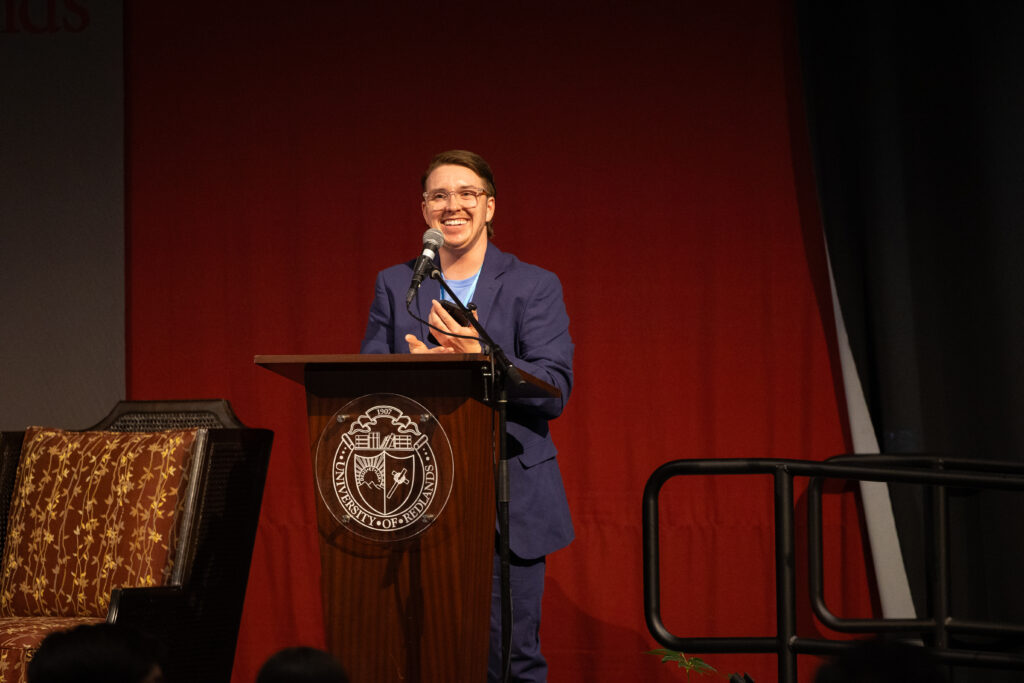
The microphone was then passed on to Nijohni Castillo ‘28, the president of the Native American Student Union (NASU), for a land acknowledgement. She interspersed her native tongue, Navajo, as she introduced herself, NASU and the land’s heritage.
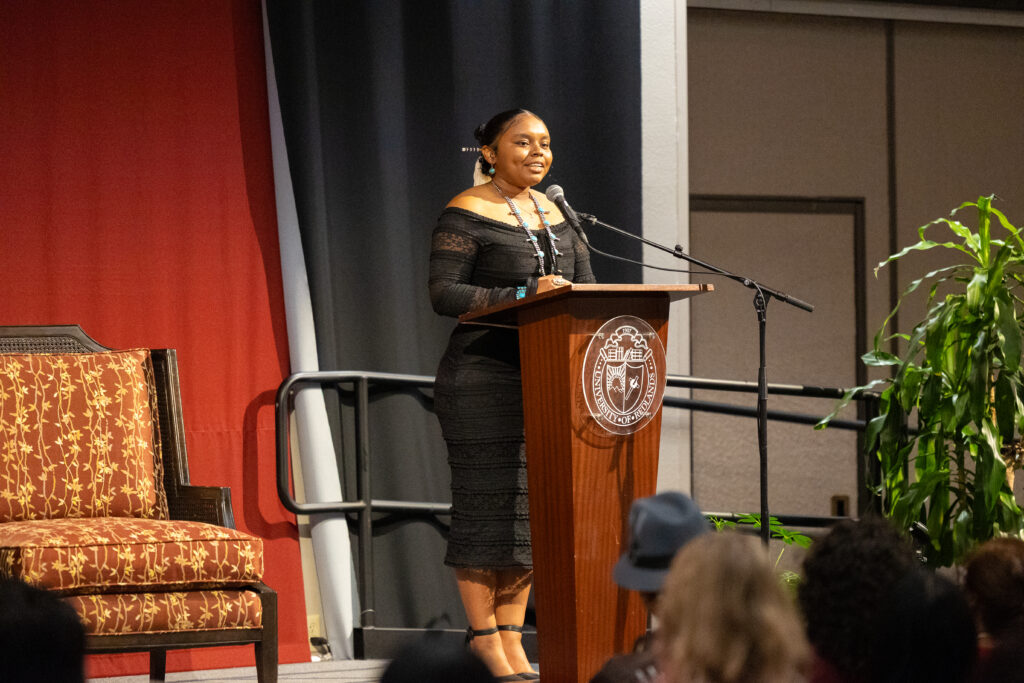
“I believe it is important to always take the time to recognize the land that we stand on, to grasp the rich history and the ongoing existence of various Indigenous cultures,” Castillo said. “This acknowledgment is crucial for advancing justice, and safeguarding the rights and sovereignty of Native American communities.”
“We would like to recognize and give thanks to this land that provided us with the space to work, study, laugh, make friends and build kinship while at Redlands,” she added.
Joining NASU as one of the several organizations promoting diversity and equality at the university, Movimiento Estudiantil Chicano de Aztlán (MEChA) was represented by their president Louie Avila ‘27. Avila provided the audience with context on Sandy Vasquez, the vice president of student affairs who would be acting as the evening’s moderator, and keynote speaker Huerta.
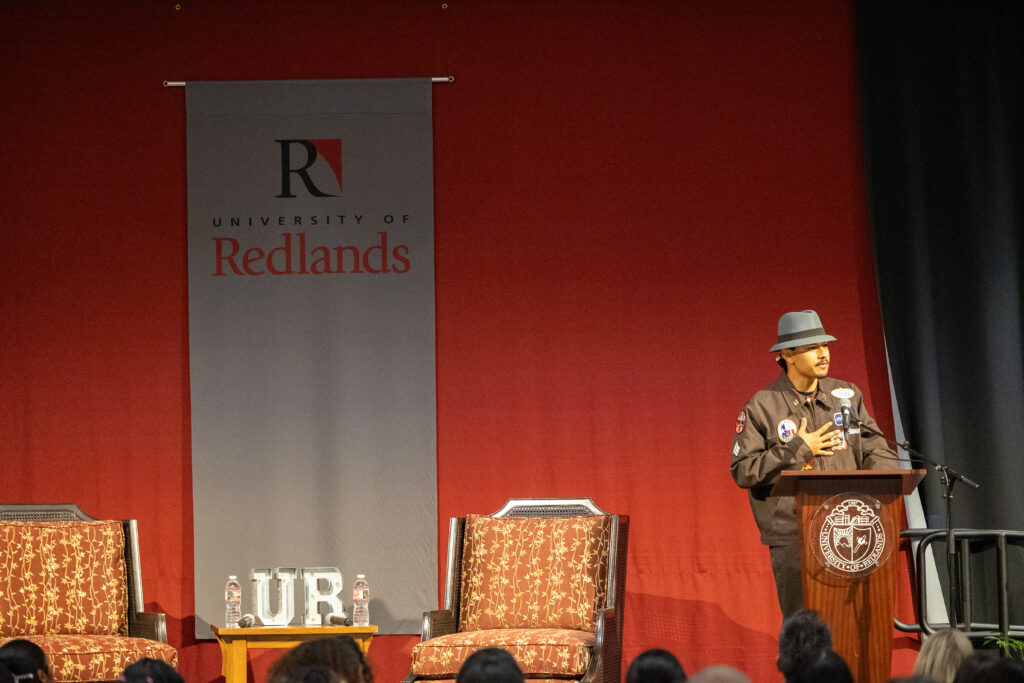
“As this campus moves toward an evolving entity that represents all, Sandy is the first person of color that sits in her office as Vice President of Student Affairs for the University of Redlands,” he said. “We thank you for all that you do, and we love you. Please continue to make this campus a space for all of us to thrive.”
Switching over to Huerta, Avila described her early life and motives for engaging in activism. He reviewed her civil rights efforts like increasing voter registration among minorities and improving treatment for agricultural workers by helping form the United Farm Workers organization.
“Battling the norms of gender roles and the racist culture of the United States, Dolores Huerta paved the way for equality, equity and justice to be received by marginalized and underprivileged communities in the US,” he said. “Her presence walks into the room before she is announced.”
Avila listed several of Huerta’s honors and awards, including her 1993 induction into the Women’s Hall of Fame, 1998 Eleanor D. Roosevelt Human Rights Award and 2012 Presidential Medal of Freedom.
“So much more succeeds her name, and tonight we have the privilege of engaging with our history,” he said.
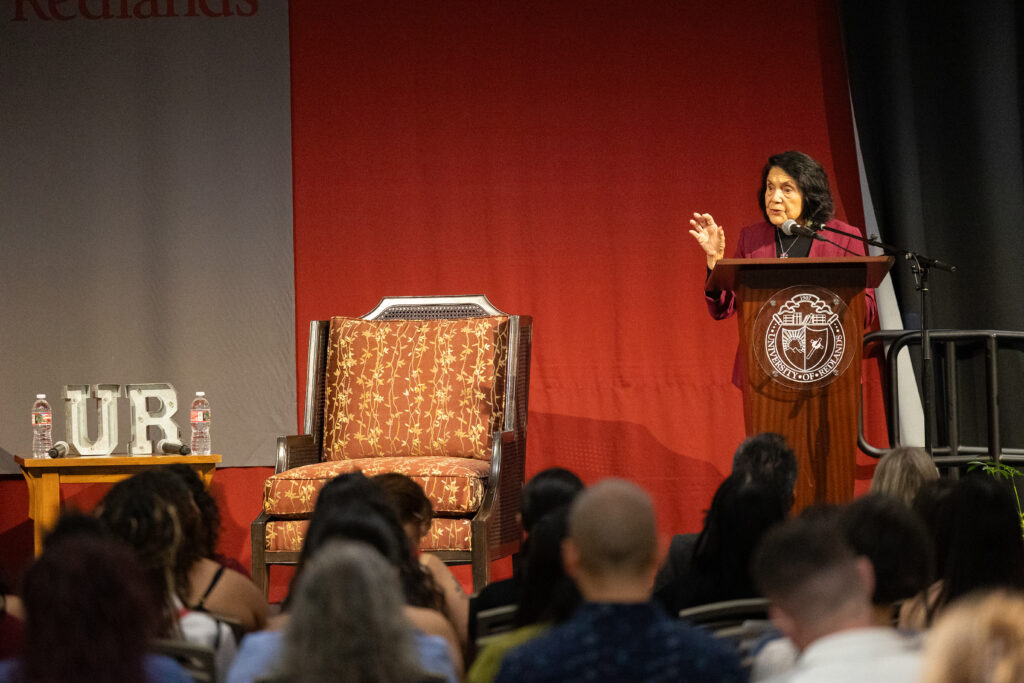
Dolores Huerta Takes the Mic
Huerta started off her speech by shedding light on her experience in grassroots activism and the lessons she learned. For instance, she said fear of repercussions tends to initially dominate grassroots efforts but must be overcome.
“The people that are oppressed, they know what the issues are,” she said. “They know what the problems are, and they have the intelligence to be able to solve their own problems.”
Huerta also highlighted collaboration’s significant role, pointing to the successful 1965 Delano Grape Strike where tens of thousands of people boycotted grapes for five years. Rarely do such feats come without losses, though. Huerta recalled the names and characteristics of five people who died during that struggle, from an 18-year-old Jewish woman in Florida to a 21-year-old Muslim in California.
“They are the ones that had to die to get the basic minimum things for farm workers,” she said.
Those basic necessities included bathrooms in the fields, cold drinking water and breaks.
Huerta transitioned forward 60 years to today’s civil rights issues. She described passing an immigration detention center on her way to Redlands and how she feels many of its detainees — gardeners, construction workers, nannies — do not belong there. Whereas the government used to repatriate undocumented people, she said it is now confining them indefinitely in these centers, many of which have documented inhumane conditions. She spoke against the use of taxpayer dollars to fund detention centers as well as new wars abroad.
In alignment with this year’s Social Justice Conference theme, Huerta said an opportune moment for influencing change is approaching with this November’s midterm elections where congressmembers are elected.
“We have to take all of those dumb oxen out of Congress,” she said, without naming specific individuals, in both Spanish and English.
Huerta followed this call to action with advice for activists, advising them to refrain from violence as it always ricochets back. She called on activists to go beyond just talking about social justice and commit themselves to action, which she said is what actually drives change.
Questions & Answers
Vasquez joined Huerta on stage for a moderated discussion with questions that had been submitted by students prior to the conference. The first question revolved around how modern activism approaches differ from historic ones, like her own. Huerta said there are lessons to be learned from previous social justice activism, but today’s approach will be tailored by the tools available. She pointed out that technology, specifically, can be advantageous but also complicate things.
“Education without action doesn’t go very far,” she said.
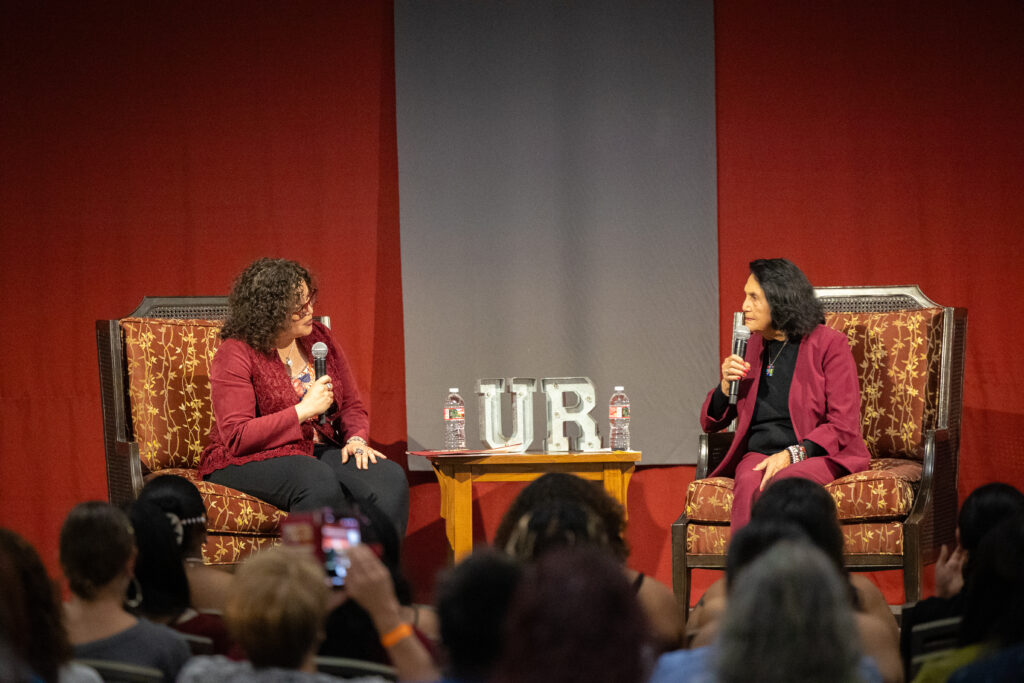
The second question centered on Huerta’s balance of activism efforts with other aspects of life. To this, Huerta said helping others — not making money — should be the primary focus. She said this was ingrained into her by her mother’s strong devotion to St. Francis and his selfless generosity.
The last question asked what inspired the civil rights activist’s journey, which Huerta said was the power she unlocked when she figured out how to organize efforts: gather people, make them take direct nonviolent action, and change will result.
“It was like discovering a pot of gold at the end of a rainbow,” she said.
‘The World That We Need’
The 96-year-old Huerta concluded the night with several spirited calls to action.
“We’re going into battle right now to save our country, to save our democracy,” she said. “But we have to do a little bit of cleansing.”
Huerta identified the legacy of slavery, discrimination and pedophilia as several issues to address. She invoked humanity’s common ancestry in the Fertile Crescent of Africa, inviting the audience to hold hands with their neighbor and say, “Hello, African relative.”
Huerta then led the audience in several chants, including her iconic “Sí, se puede” with rhythmic clapping.
“I want you to shout the answers really, really loud so that the haters can hear us,” she said.

As the clapping faded and the audience resumed their seats, Huerta shared her confidence in a hopeful future.
“We’re going to go marching forward,” Huerta said. “You are all going to create the new world – the world that we need.”
This was met by a standing ovation, after which Vasquez presented Huerta with a gift from the university and announced the establishment of an award in her honor. The Dolores Huerta Civic Leadership Medallion, Vasquez said, will annually recognize an undergraduate student who demonstrates exceptional commitment to community leadership, advocacy, and social change.
Backstage Pass
A group photo to commemorate the special evening was taken and then attendees dispersed, with several student leadership organizations, including The Redlands Bulldog, given the opportunity to meet Huerta and take pictures.
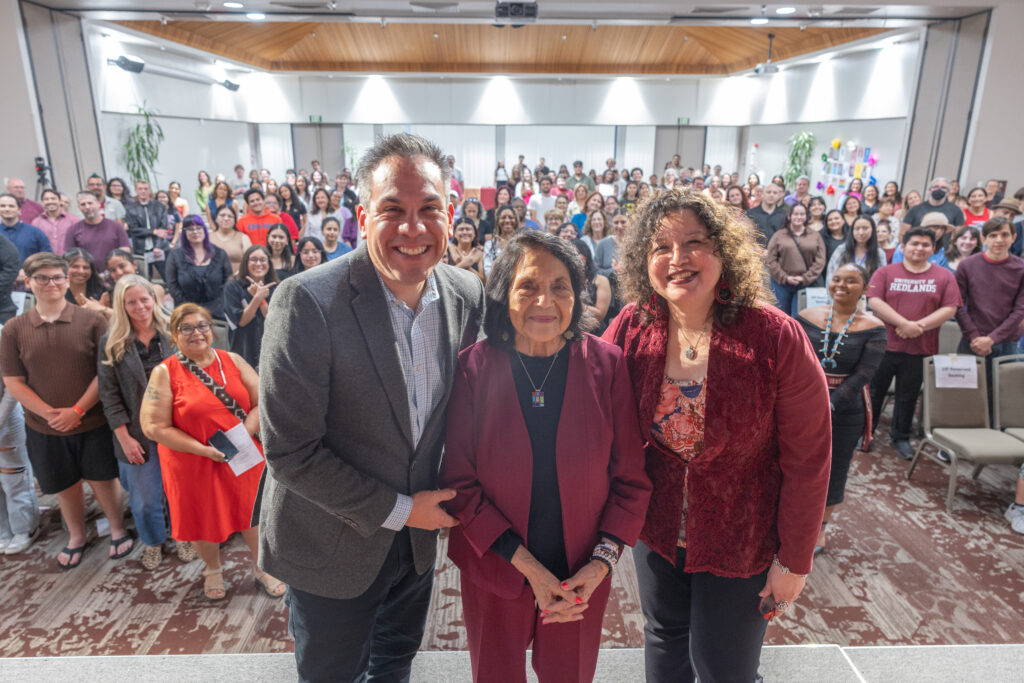
When asked for her most memorable experiences in civil rights activism, Huerta promptly recalled being arrested. This occurred more than 20 times, she said, and often while picketing.
Huerta said her longest jail sentence was two weeks in an institution near Delano, California, where many of the other inmates were Muslim. She said the prison fed them pork — intentionally violating their Islamic dietary restrictions — so the inmates threw their plates on the walls. Huerta said they also made quite the ruckus with prayers and hymns, chuckling as she remembered their defiance.
As for why college students should learn about her activism efforts, Huerta said the nation is at a critical point in its history. She compared what she sees as increasing sexism and racism in the U.S. to Germany before Hitler cemented his control.
“Our democracy is in danger,” she said.
Even college students, she said, can be active advocates for social justice through voting, protesting and boycotts. They may not have strength in resources, she said, but they have strength in numbers.
Editor’s Note: The March 13 Social Justice Conference took place before the New York Times published an investigation into sexual assault allegations against César Chávez, Dolores Huerta’s colleague in the United Farm Worker labor movement — including allegations from Huerta herself. In light of the news, University of Redlands President Krista Newkirk sent a campuswide email last week stating that the university is redesignating its César Chávez Day holiday as Farmworkers Justice Day and will look into separating it from Chávez’s birthday.

McKenzie Rose, a sophomore double-majoring in Environmental Studies and Journalism, serves as the Redlands Bulldog Editor-in-Chief this semester. McKenzie first dabbled in the world of journalism during high school by working as a freelance reporter with the municipal Hermiston Herald and regional East Oregonian newspapers near her hometown of Echo, Oregon. She enjoys running (participating in the university’s track & field and cross country teams), spending time with her pets, traveling and listening to good ‘ol country music!